

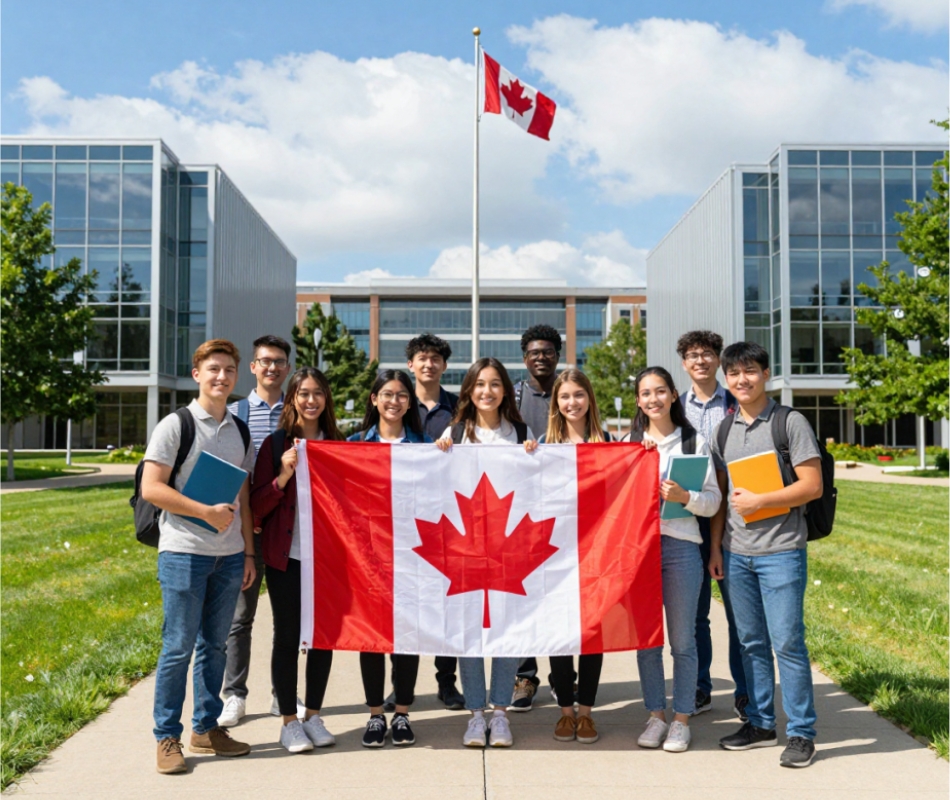

Study in Canada from Pakistan
Study at Canadian Universities & Colleges | Canada Study Permit Guidance | Admissions | PGWP Planning | Student Visa Assistance

Looking to Study in Canada?
Canada continues to be one of the world’s leading destinations for international education, offering globally recognized universities and colleges, diverse academic programs, opportunities for eligible students to work during their studies, and potential post-study work opportunities.
However, Canada’s international student system has changed substantially in recent years. Students applying must carefully consider not only university or college admission requirements but also the Designated Learning Institution (DLI), Provincial or Territorial Attestation Letter requirements, financial requirements, Post-Graduation Work Permit eligibility, field-of-study rules, and spouse work permit restrictions before choosing a program.
At Superior Consulting, we assist students with strategic program selection, admission applications, documentation, study permit preparation and complete Canada study planning.
Why Study in Canada?
Canada offers international students access to a sophisticated education system with programs ranging from diplomas and bachelor’s degrees to professional qualifications, master’s degrees and PhDs.
- Internationally recognized Canadian qualifications
- Universities and colleges offering a wide range of academic and professional programs
- Opportunities for eligible students to work while studying
- Potential eligibility for a Post-Graduation Work Permit (PGWP) after completing an eligible program
- Canadian work experience after graduation for eligible PGWP holders
- Opportunities to explore future Canadian permanent residence programs, subject to meeting the applicable immigration requirements
- Possibility for certain students to bring their spouse or common-law partner and dependent children
- Multicultural communities and internationally diverse campuses
- Programs in technology, engineering, healthcare, business, education, trades, sciences and other fields
Students should nevertheless understand that studying in Canada does not automatically result in a PGWP or permanent residence. Course selection needs to be planned carefully under current Canadian immigration rules.
Important Canada Study Permit Changes
Canada has introduced significant reforms to its International Student Program.
For 2026, IRCC expects to issue up to 408,000 study permits, including approximately 155,000 permits for newly arriving international students and approximately 253,000 permits for extensions and returning students.
This makes careful selection of the institution, program and application strategy particularly important.
1. PAL/TAL Requirement Continues for Many Students
Most applicants who require a study permit must obtain a Provincial Attestation Letter (PAL) or Territorial Attestation Letter (TAL) from the province or territory in which they intend to study.
The PAL/TAL confirms that the student has been allocated a place within the province or territory’s international student allocation.
A PAL/TAL is generally obtained through the student’s designated learning institution after admission and, depending on the institution, may require acceptance of the offer and payment of some or all required tuition/deposit.
For Quebec, students normally require a Quebec Acceptance Certificate (CAQ) under Quebec’s separate requirements.
2. Public University Master’s and PhD Students Are Exempt from PAL/TAL in 2026
A major positive change applies from January 1, 2026.
Students applying for a degree-granting master’s or doctoral program at a public Designated Learning Institution are exempt from the PAL/TAL requirement.
The exemption does not automatically apply to every postgraduate certificate, graduate diploma or private institution program.
This makes properly selected public-university master’s and doctoral programs particularly important options for suitably qualified international students.
3. Student Direct Stream Has Ended
Canada’s former Student Direct Stream (SDS), which was previously available to applicants from Pakistan and several other countries, ended on November 8, 2024.
New Pakistani study permit applications are therefore processed through Canada’s regular study permit system rather than SDS.
A GIC can still potentially be used as evidence of financial capacity, but there is no longer a separate SDS application route.
- Study in Canada
- Study in Canada
- Study in Canada
- Study in Canada
- Study in Canada
- Study in Canada
Canada Study Permit Eligibility Requirements
To obtain a Canadian study permit, an applicant generally needs to demonstrate that he or she:
- Has been accepted by a Designated Learning Institution (DLI)
- Has a valid Letter of Acceptance
- Provides a PAL/TAL where required
- Has sufficient funds for tuition
- Has sufficient funds for living expenses
- Has sufficient funds for transportation to and from Canada
- Has sufficient funds for accompanying family members, where applicable
- Is law-abiding and does not have a disqualifying criminal history
- Completes a medical examination where required
- Meets Canadian admissibility requirements
- Satisfies the immigration officer that the applicant will comply with the conditions of temporary residence and leave Canada at the end of the authorized stay if no further lawful status is obtained
IRCC specifically requires applicants to establish sufficient financial capacity without relying on employment in Canada to finance their studies.
Choosing a Designated Learning Institution – DLI
An international student should normally select a Canadian institution that appears on Canada’s official Designated Learning Institution List.
However, an important distinction must be understood:
Being a DLI does not automatically mean that every program offered by that institution is eligible for a Post-Graduation Work Permit.
Students whose objective includes obtaining a PGWP after graduation should confirm:
Students should nevertheless understand that studying in Canada does not automatically result in a PGWP or permanent residence. Course selection needs to be planned carefully under current Canadian immigration rules.
- Whether the institution is a DLI;
- Whether the particular program is PGWP eligible;
- Whether the program meets any applicable field-of-study requirement;
- Whether the program duration supports the desired PGWP duration;
- Whether the student will later satisfy the applicable PGWP language requirement.
Canada Study Permit Eligibility Requirements
To obtain a Canadian study permit, an applicant generally needs to demonstrate that he or she:
- Has been accepted by a Designated Learning Institution (DLI)
- Has a valid Letter of Acceptance
- Provides a PAL/TAL where required
- Has sufficient funds for tuition
- Has sufficient funds for living expenses
- Has sufficient funds for transportation to and from Canada
- Has sufficient funds for accompanying family members, where applicable
- Is law-abiding and does not have a disqualifying criminal history
- Completes a medical examination where required
- Meets Canadian admissibility requirements
- Satisfies the immigration officer that the applicant will comply with the conditions of temporary residence and leave Canada at the end of the authorized stay if no further lawful status is obtained
IRCC specifically requires applicants to establish sufficient financial capacity without relying on employment in Canada to finance their studies.
Academic Requirements for Studying in Canada
Admission criteria are determined by the individual Canadian university, college and program.
Depending on the level of study, an applicant may need:
Undergraduate / Bachelor’s Degree
Normally:
- Higher Secondary School Certificate, A-Levels, Intermediate or equivalent qualification
- Required academic grades
- Subject prerequisites for the selected program
- Proof of English or French proficiency where required by the institution
Postgraduate or Graduate Certificate
Normally:
- Bachelor’s degree or other required post-secondary qualification
- Relevant academic background where applicable
- English-language proficiency
- Additional professional experience for certain programs
Applicants considering non-degree programs should carefully check current PGWP field-of-study requirements before enrolling.
Master’s Degree
Requirements may include:
- Recognized bachelor’s degree
- Required GPA or academic standing
- English/French proficiency
- Statement of purpose
- Academic references
- CV/resume
- Relevant work experience for certain programs
- GMAT/GRE where required
PhD / Doctoral Program
Requirements commonly include:
- Relevant master’s degree or equivalent academic preparation
- Strong academic record
- Research proposal or research interests
- Academic references
- CV
- Research experience
- Identification of a potential supervisor in some programs
- English/French language requirements
Is IELTS Required to Study in Canada?
There is no single universal IELTS score imposed by IRCC for every Canadian study permit applicant.
Language requirements for admission are established by the Canadian institution and the individual program. Institutions may accept examinations such as IELTS, TOEFL, PTE or other approved evidence depending on their admission policies.
Students must therefore satisfy the specific admission requirements of the university or college they choose.
Language requirements are also relevant after graduation because the PGWP now has separate language requirements for many graduates.
Proof of Funds for Canada Study Permit – 2026
Students must prove that they have enough money to cover:
Tuition fees + living expenses + transportation costs
For applications made on or after September 1, 2025, the minimum living-expense requirement for provinces and territories other than Quebec is:
| Family Size Including Student | Minimum Living Funds per Year |
|---|---|
| 1 person | CAD 22,895 |
| 2 people | CAD 28,502 |
| 3 people | CAD 35,040 |
| 4 people | CAD 42,543 |
| 5 people | CAD 48,252 |
| 6 people | CAD 54,420 |
| 7 people | CAD 60,589 |
| Each additional person | CAD 6,170 |
Examples of Acceptable Financial Evidence
Depending on the applicant’s circumstances, financial documents can include:
- Bank statements
- Evidence of tuition payment
- Student or education loan
- Canadian bank account evidence
- Guaranteed Investment Certificate (GIC)
- Bank draft
- Scholarship evidence
- Sponsor’s financial evidence
- Sponsor’s income or employment documents
- Evidence explaining the source and availability of funds
IRCC lists bank statements for the previous four months among common forms of financial evidence.
A strong application should demonstrate not merely the existence of money, but also its availability, source, consistency and credibility.
Tuition Fees in Canada
Canadian tuition fees vary significantly depending on:
- Institution
- Province
- Program
- Degree level
- Field of study
According to Statistics Canada’s 2025/2026 data, average international tuition at publicly funded Canadian degree-granting institutions was approximately:
- CAD 41,746 per year for international undergraduate students
- CAD 24,028 per year for international graduate students
Actual tuition can be substantially lower or higher depending on the university and program.
Students should therefore obtain the precise tuition schedule directly from the institution before preparing their financial plan.
Can International Students Work While Studying in Canada?
To obtain a Canadian study permit, an applicant generally needs to demonstrate that he or she:
Eligible international students can work up to 24 hours per week off campus during regular academic sessions without obtaining a separate work permit, provided they satisfy the applicable conditions.
During regularly scheduled academic breaks, eligible students may work unlimited off-campus hours.
To qualify for off-campus work, the student generally needs to:
- Hold a valid study permit with appropriate work authorization
- Have started the study program
- Be studying full-time at an eligible DLI, subject to limited exceptions
- Be enrolled in an eligible academic, vocational or professional program
- Be studying in a program of at least six months that leads to a degree, diploma or certificate
Students enrolled only in English or French as a second-language programs normally cannot work off campus under the standard student work authorization.
Students must not use anticipated Canadian employment income as a substitute for the financial resources required for the study permit application.
Post-Graduation Work Permit – PGWP
The Post-Graduation Work Permit can allow eligible graduates to obtain valuable Canadian work experience after completing an eligible program.
A PGWP can generally be issued for a period ranging from eight months to three years, depending on factors including program type and duration.
Not every Canadian program qualifies.
PGWP Requirements for Bachelor’s, Master’s and Doctoral Graduates
Graduates of bachelor’s, master’s and doctoral degrees currently:
- Do not have a PGWP field-of-study restriction
- Must meet a minimum language standard of CLB/NCLC 7 in all four abilities, where the current language requirement applies
PGWP Requirements for Other University Programs
For university programs other than bachelor’s, master’s and doctoral degrees:
- Minimum CLB/NCLC 7 language ability is generally required; and
- Students whose study permit application was submitted on or after November 1, 2024 may need to graduate in an eligible field of study.
PGWP Requirements for College, Polytechnic and Other Non-University Programs
Graduates of eligible college, polytechnic and other non-university programs generally need:
- Minimum CLB/NCLC 5 in all four language abilities; and
- An eligible field of study where the field-of-study requirement applies.
PGWP Eligible Fields of Study
For programs subject to the field-of-study requirement, eligible programs are linked to occupations experiencing long-term labour shortages.
Current categories include areas within:
- Agriculture and agri-food
- Education
- Healthcare and social services
- Science, Technology, Engineering and Mathematics (STEM)
- Trades
- Transport
IRCC has confirmed that the PGWP field-of-study list is frozen for 2026, meaning no eligible fields are scheduled to be added or removed during 2026.
Because individual eligibility depends on the exact six-digit Classification of Instructional Programs (CIP) code, students should verify the precise CIP code of the proposed program rather than relying only on the program’s marketing title.
Can a Master's Graduate Receive a Three-Year PGWP?
Potentially, yes.
Special PGWP rules can allow eligible graduates of qualifying master’s degree programs to receive a PGWP of up to three years, subject to meeting the applicable eligibility requirements.
This makes carefully selected master’s degree programs particularly attractive for applicants who qualify academically.
A PGWP is never automatic and the applicant must satisfy the rules applicable at the time of application.
Can My Spouse Work in Canada While I Study?
The rules for spouses and common-law partners of international students are now significantly more restrictive than they were previously.
From January 21, 2025, a spouse or common-law partner may generally qualify for a student-spouse open work permit where the principal student holds a valid study permit and is studying in:
- A master’s degree program of 16 months or longer
- A doctoral degree program
- Certain specifically eligible programs
- Certain eligible professional university degree programs
Eligible professional degrees currently include specified programs in areas such as:
- Medicine
- Dentistry
- Law
- Optometry
- Pharmacy
- Veterinary medicine
- Nursing
- Education
- Engineering
A spouse is therefore not automatically entitled to an open work permit simply because the principal applicant is an international student.
The student’s exact program must be evaluated before a family strategy is planned.
Can Children Accompany an International Student?
Dependent children may potentially accompany an international student, subject to Canadian immigration requirements and the appropriate temporary resident documentation.
Where children will attend school in Canada, their status and documentation should be planned as part of the family’s overall application strategy.
Applicants travelling as a family must also demonstrate the required additional financial resources.
Can International Students Obtain Permanent Residence in Canada?
Studying in Canada is not itself a permanent residence program.
However, an eligible graduate may potentially build a future immigration strategy through Canadian education and qualifying Canadian work experience.
Depending on the applicant’s circumstances and the immigration programs available at the relevant time, possible future pathways may include:
- Express Entry
- Canadian Experience Class
- Provincial Nominee Programs
- Provincial graduate streams
- French-language immigration pathways
- Other federal or provincial economic immigration programs
Eligibility depends on factors such as age, education, language ability, occupation, Canadian work experience, province of residence and immigration rules applicable at the time.
No institution, education consultant or immigration representative can legitimately guarantee Canadian permanent residence merely because a student enrols in a Canadian program.
Changing Colleges or Universities in Canada
International students should be cautious about changing institutions after receiving a study permit.
Under current rules, post-secondary students generally cannot simply change their DLI and continue studying under the original authorization. A student changing institutions may need to obtain a new study permit and follow IRCC’s applicable DLI-change procedure.
Students should therefore select their institution carefully before applying.
Canada Study Permit Government Fees
Current federal fees include:
Study Permit Application: CAD 150 per applicant
Biometrics: CAD 85 per individual applicant, where biometrics are required.
For an eligible family applying together, the biometrics fee is capped at CAD 170.
Additional costs can include:
- University/college application fees
- Tuition deposit
- Medical examination
- Police certificates where required
- Document translation
- Biometrics/VAC-related services
- Travel
- Health insurance
- Provincial requirements
- Professional consultation or representation fees
Canada Student Visa Application Process
Step 1 – Student Profile Assessment
We evaluate:
- Academic history
- Age and study gap
- Employment history
- Previous qualifications
- Proposed field of study
- Career progression
- Budget
- English proficiency
- Family circumstances
- Immigration history
- Previous visa refusals, if any
Step 2 – Course and Institution Selection
The program should make academic and professional sense.
Where post-study work is an objective, we also evaluate:
- DLI status
- PGWP eligibility
- Program duration
- CIP code
- Field-of-study requirement
- PGWP language requirement
Spousal work permit implications
Step 3 – Admission Application
Applications are prepared and submitted to suitable Canadian institutions.
Step 4 – Letter of Acceptance
If admitted, the institution issues a Letter of Acceptance subject to its admission and payment requirements.
Step 5 – PAL/TAL or CAQ Where Required
Students obtain the relevant provincial or territorial documentation where applicable.
Step 6 – Financial Documentation
A comprehensive financial package is prepared demonstrating tuition, living expenses, transportation costs and the source of funds.
Step 7 – Study Plan / Statement of Purpose
The application should clearly explain:
- Why Canada has been selected
- Why the particular course has been selected
- Why the particular institution is appropriate
- How the program relates to the student's previous education and/or career
- How the qualification supports future professional objectives
- The applicant's overall circumstances and temporary-resident compliance
Step 8 – Study Permit Application
The completed application and supporting documents are submitted to IRCC.
Step 9 – Biometrics and Medical Examination
Biometrics and an immigration medical examination are completed where required.
Step 10 – Decision and Pre-Departure Preparation
Once approved, the applicant should review the conditions of the approval, travel documentation, institution reporting date and study permit requirements before travelling.
Why Canada Study Permit Applications Are Refused
Obtaining admission from a Canadian university or college does not guarantee study permit approval.
Common areas of concern can include:
- Weak or inconsistent study plan
- Course unrelated to previous education or employment without a convincing explanation
- Unexplained academic or employment gaps
- Insufficient finances
- Unclear source of funds
- Sudden large bank deposits without adequate explanation
- Weak evidence of financial sustainability
- Questionable documentation
- Inconsistent information between forms and supporting documents
- Previous immigration history
- Failure to establish compliance with temporary resident requirements
- Inappropriate course selection
- Failure to disclose previous refusals or material facts
This is why admission planning and visa planning should ideally be conducted together rather than treated as two unrelated processes.
How Superior Consulting Can Assist With Study in Canada
Choosing a Canadian course solely on the basis of admission availability is no longer enough.
Under the current system, the wrong selection can affect:
- Study permit strategy
- PAL/TAL requirements
- PGWP eligibility
- PGWP duration
- Field-of-study eligibility
- Spousal work permit eligibility
Future Canadian immigration options
Superior Consulting provides strategic, end-to-end assistance for students planning to study in Canada.
We assess your academic profile, employment background, finances, study gap and intended career direction before recommending programs.
We shortlist suitable Canadian universities and colleges based on your academic background, budget and career objectives.
Where post-study work is an objective, we review the DLI, PGWP status, program level, program duration and applicable CIP/field-of-study rules.
We assist with preparing and submitting university and college admission applications and coordinating application requirements.
We help prepare a detailed and professionally structured study plan based on the applicant’s genuine academic, professional and financial circumstances.
We assist applicants in organizing and presenting evidence of tuition, living funds, sponsorship and source of funds.
Where required, we guide applicants regarding applicable provincial documentation.
We assist with the preparation and review of the Canadian study permit application and supporting documents.
For married applicants, we assess whether the selected program may support spousal open work permit eligibility and how accompanying family applications should be structured.
Successful students can also receive guidance regarding documentation required for travel and entry into Canada.
Start Your Study in Canada Journey With Superior Consulting
Your Canadian education plan should begin with the right course, right institution and right immigration strategy.
Before paying a tuition deposit, determine:
- Is the institution a DLI?
- Is the selected program PGWP eligible?
- Does a field-of-study requirement apply?
- What is the program’s CIP code?
Is a PAL/TAL required? - Does the program support your academic and professional background?
- Do you meet Canada’s financial requirements?
- Can your spouse qualify for an open work permit?
Our team can assess these issues before you proceed.
Contact Superior Consulting
Superior Head Office Karachi Details:
Pakistan UAN: (021) 111-002-345
Karachi Lines: +92-21-35658107 to 09
Additional Lines: +92-21-35657361 and 35657362
Mobile: +92 334 3522967
WhatsApp: +92 334 3522967
Email: info@superior.com.pk
Dubai Office Details:
Call or WhatsApp: +971 56 171 2877
Alternative UAE contact: +971 50 947 6307
Send Us Email: info@superiorglobal.ae
Book a Professional Consultation
A 30-minute professional consultation is available for PKR 5,000. The consultation fee is adjustable against our professional service fee when you retain Superior Consulting within 30 days, subject to the applicable terms.
FREQUENTLY ASKED QUESTIONS
For an assessment, contact:
study@superior.com.pk
+92 302 8286793
Disclaimer: Canadian immigration, admission and PGWP rules can change. Admission, study permit approval, work permits and permanent residence are subject to the requirements and discretion of the relevant institution and Canadian authorities. No admission, visa, PGWP or permanent residence outcome can be guaranteed.
Obtaining admission from a Canadian university or college does not guarantee study permit approval.
Common areas of concern can include:
- Weak or inconsistent study plan
- Course unrelated to previous education or employment without a convincing explanation
- Unexplained academic or employment gaps
- Insufficient finances
- Unclear source of funds
- Sudden large bank deposits without adequate explanation
- Weak evidence of financial sustainability
- Questionable documentation
- Inconsistent information between forms and supporting documents
- Previous immigration history
- Failure to establish compliance with temporary resident requirements
- Inappropriate course selection
- Failure to disclose previous refusals or material facts
This is why admission planning and visa planning should ideally be conducted together rather than treated as two unrelated processes.